ARCHBISHOP TESTA AND THE CONSTRUCTION OF THE ROAD-MONUMENT BETWEEN THE FORTRESS AND MONREALE
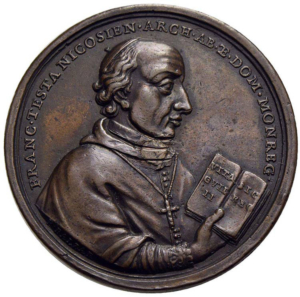
Everyone knows that Monreale was founded in the 12th century during the Norman domination. Few, however, know that the town was refounded in the second half of the 18th century. During those years, its streets were widened, schools reformed and the water system was improved. This great work of urbanisation and public decorum was funded by Francesco Testa, Archbishop of Monreale between 1754 and 1773.
The most obvious achievement is the “road-monument” built to connect Monreale to the capital, Palermo.
The site was opened on 16 October 1762: it was necessary to start by removing the rocks, a work still filed and preserved in the Palermo State Archives, the days of work, the amount of money paid and the amount of explosives used, the names of the workers, and technical information on the execution of the work, everything is still archived to this days.
In the street-monument, the sculptures are entrusted to Ignazio Marabitti, the artist who maintained a privileged relationship with Francesco Testa for thirty years. Leaving the Rocca, heading towards Monreale, the street opens with an entrance emphasised by two pillars with vases bearing a Latin and Greek inscription, to mark the merits of the teachings given at the Monreale Seminary. The pylons are still there, built by Filippo Pennino, Marabitti’s first pupil and son of art.
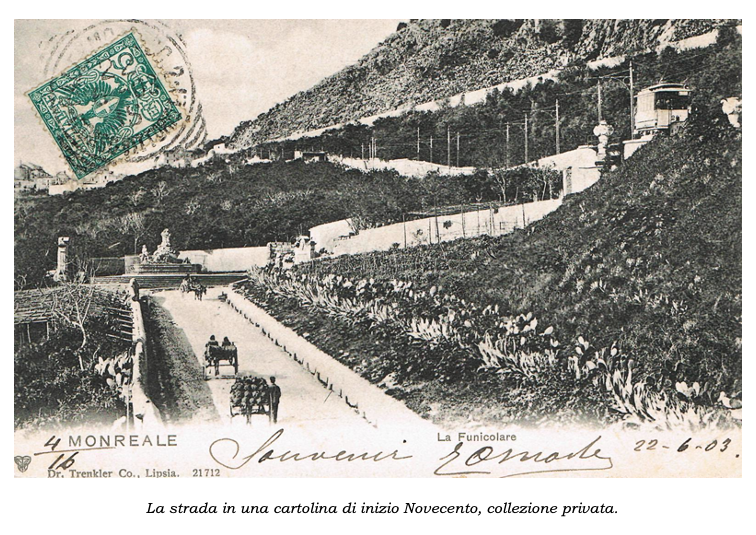
The road is outlined with two sharp bends. Inside the first bend we can witness the Fountain of the Fisherman, so called because of a boy sculpted in the act of fishing: it has a circular basin, cherubs and naturalistic elements.
The inside of the second curve is occupied by a semicircular seat, bordered by pillars: it is what remains of a more complex architectural structure, with pyramids and inscriptions that accompanied the wayfarer.
Halfway down the road, we can admire the most scenic monument: the Dragon Fountain. With its pyramidal profile, it reproduces a scheme typical of seventeenth century Palermo: the dragon is a metaphor for the darkness destined to be defeated, the shell in the foreground (typical of Baroque decorativism) is emphasised as a symbol of Palermo, a fertile ‘golden basin’ that welcomes the waters poured from the Oreto river. The final composition takes andvantage of the slope of the mountain, giving the idea that the children escape the dragon by climbing the mountain.
On July 1767, the road is completed, stopping in front of the gate of San Michele.
The road, decorated with fountains and sculptures, is often admired by contemporaries as an magnificent architectural artefact and is thus described by travellers who discovered Sicily at the end of the 18th century.
The most famous traveller being Johann Wolfgang Goethe, who visited island in 1787 and was mostly silent on the mosaics of the cathedral but not on the road, writing: «today we have visited Monreale: a magnificent road leads to the city, built by the abbot of the monastery in times of great plenty, wide, easy to climb, with trees to the right and left, but above all provided with copious fountains and jets of water with friezes and ornaments».