
PILLS OF HISTORY
Monreale is located on the slopes of Mount Caputo, overlooking the Oreto valley and the Conca d’Oro, a few kilometers from Palermo. The town, founded by the Normans on a pre-existing Arab settlement, is the most important tourist center in the province. Its history begins with the construction of the cathedral.
A popular legend on the foundation of the city tells the story of king William II, tired after a hunting trip, who fell asleep under a carob tree; he dreamt of Our Lady (The Virgin Mary) revealing to him the hiding place of a treasure. He dug a hole under that tree until he found a very rich treasure and thus began the construction of the new church that would amaze the world.
Historians have given a different reading by noting how Sicily returned to Christianity with the arrival of the Normans, the struggle for power soon began. Two parties were formed, the barons and the archbishop of Palermo siding against the king and the pope allied with each other: the result was the construction of a massive complex dedicated to Our Lady right on the outskirts of Palermo; it would be the sovereign who would bring men to populate and defend the newly founded city. The miracle of the building of the cathedral is soon accomplished, Byzantine, Arab and Latin craftsmen created one of the highest examples of Arab-Norman art, and Benedictines monks from Cava dei Tirreni were called in to officiate at its rites. The new church will be used as the mausoleum of the Altavilla family: William I and William II, father and son, are buried next to each other in the right aisle.
The abbey of Monreale is enriched with many possessions; a privilege drafted in 1182 in the three languages of the royal chancery-Latin, Greek and Arabic which defined its territory and declared the abbey the “mistress” of 72 fiefs: although much of the land was still in the hands of the Saracens, and only after a long internal crusade and slow repopulation, the Normans would manage to free those lands from their enemies. In 1183 Pope Lucius III granted the abbey the dignity of a metropolitan church.
Surrounded by walls where 12 towers alternate, the abbey is a fortified citadel, the most powerful among Sicilian ecclesiastical lordships during the Middle Ages. Rather than the Cluniac abbey models, the abbey possesses features more similar the mosques of Islamic cities: from the east-facing apses to the architecture of the cloister, the cathedral of Monreale tells us of a multi-ethnic but not pacified Sicily, where the Latin element slowly prevailed.
Until 1812, when the year feudality was abolished in Sicily, Monreale retained its rank of ecclesiastical lordship. It is a small theocracy, the archbishop being both the spiritual and temporal lord with the right to administer justice.
Thanks to the prestige and wealth of its archiepiscopal table, especially in the early centuries the diocese of Monreale saw the succession of archbishops belonging to the most important families of Christendom.
Some dates
in 1172 work begins;
in 1174 Pope Alexander III declared Monreale not subject to the jurisdiction of the archbishops of Palermo;
in 1183, on February 5, with the bull “Licet Dominus” Pope Lucius III elevated it to the rank of metropolitan diocese, its suffragans being the dioceses of Catania and Syracuse;
in 1590 Archbishop Ludovico II de Torres established the diocesan seminary;
in 1775, on July 7, the archdiocese of Monreale was united with that of Palermo at the request of King Ferdinand III of Sicily;
in 1802, on March 2, with the bull “Imbecillitas humanae mentis” Pope Pius VII restored Monreale as an archiepiscopal seat;
in 1937 Monreale gave its Byzantine-rite parishes for the benefit of the diocese of Piana dei Greci (now the eparchy of Piana degli Albanesi);
as of December 2, 2000, Monreale is no longer separated, becoming part of the ecclesiastical province of the archdiocese of Palermo; it retains the status of archdiocese by virtue of the more than eight centuries of indipendence. The abbey is currently ruled by Archbishop Gualtiero Isacchi, who was appointed on April 28, 2022.
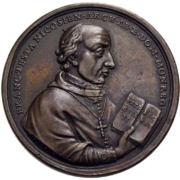
The “stradone di Mezzomonreale” was laid out in 1583 by Viceroy Marcantonio Colonna, who had thus extended the axis of the Cassaro to the village of the Rocca, at the foot of Monreale, making it also the first tree-lined public road…
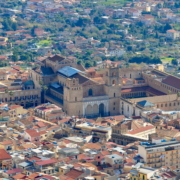
The archbishop of Monreale was spiritual and temporal lord of his diocese, which was the largest and richest diocese of Sicily: at the moment of the foundation, the church founded by the Norman William II received 72 fiefs and to observe some moments of a such important history allows us to know our roots better…
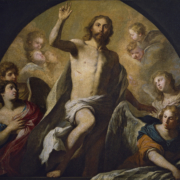
The history of Monreale is intertwined with that of two famous Monrealeses: the poet Antonio Veneziano and the painter Pietro Novelli…