
THE PLACES OF ANTONIO VENEZIANO AND PIETRO NOVELLI
The history of Monreale is deeply intertwined with that of two illustrious Monreale citizens, the poet Antonio Veneziano and the painter Pietro Novelli.
Antonio Veneziano was born in 1543 in the ‘Pozzillo’ neighbourhood, which means ‘little well’ and takes its name from a spring with an ancient fountain, located under the street level. Very close to the fountain, a plaque blackened by time commemorates the poet known as ‘the Sicilian Petrarch’ by his contemporaries.
Antonio Veneziano had an adventurous life, occasionally ending up in prison. He had excellent relations with the Church and in 1575, Archbishop Ludovico I Torres commissioned him to write the epigraph for William II’s new funeral monument; the poet also had good contacts with political power, in 1577 he was the director of the solemn entry of the new viceroy of Palermo, Marcantonio Colonna.
In 1578 Antonio Veneziano left Palermo to go to Spain. However, he was captured by pirates and taken to Algiers where he stayed for almost a year. In prison, he met Miguel de Cervantes, the author of Don Quixote, and became his friend. He returned to Monreale but later, suspected of being the author of a cartel against the viceroy’s policies, he was imprisoned again. He was released and then locked up again when a new cartel appeared. In the summer of 1593, he was confined in the Castello a Mare in Palermo. On 2 August, he was killed in the explosion of a gunpowder store. His remains were buried in the church of San Vito in Monreals, but the remainings have been lost. His most important work is the songbook in Sicilian ‘Celia’, which owes its title to the nickname of the woman he loved.
Pro Loco has made a video on Antonio Veneziano.
https://www.youtube.com/watch?v=M6erAV8n920&t=8s
Pietro Novelli was born in Monreale in 1603, he was the son of the painter Pietro Antonio Novelli, whose painting ‘Madonna del popolo in gloria’ (Our Lady of the People in Glory) is still above the altar of the Church of San Castrense. He was a young prodigy, showing his talent from a young age; his father made him study in Palermo, then he went to Naples and Rome, always working on improving his art. He soon became the most sought after painter of his time, author of numerous paintings partly preserved in our area.
Some large paintings are to be found in San Martino delle Scale: in 1629 in the vault of the refectory he painted the fresco ‘Daniel in the Lion’s Den’; in 1635 he produced a large canvas depicting St Benedict offering the rule to the monastic and chivalric orders. The same theme was depicted in the Benedictine monastery in Monreale: the grandiose painting created for the refectory can be seen today on the staircase of the Guglielmo II Monumental Complex.
Novelli’s painting activity can be witnessed in Monreale in the Church of the Odigitria and the church in the Carmine district. His ‘Guardian Angel’, a canvas commissioned in 1639 by the Monreale Consulate of Trades, originally conserved in the Church of the Madonna dell’Orto, is exhibited in the Diocesan Museum.
Pro Loco has made a video on Pietro Novelli.
https://www.youtube.com/watch?v=Y4c-1Sl7rtA
Pietro Novelli’s daughter Rosalia, one of the most important painters of her era but of whom very little is known, also worked in Pietro Novelli’s workshop. Pro Loco has made a video on Rosalia Novelli.
https://www.youtube.com/watch?v=uNo2cTTlLjY&t=46s
Here is an interactive map showing an itinerary with an artistic-literary flavour to discover these two illustrious Monrealese personalities
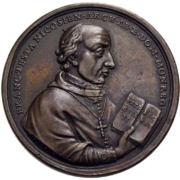
The “stradone di Mezzomonreale” was build in 1583 by Viceroy Marcantonio Colonna, who had thus extended the axis of the Cassaro to the village of the Rocca, at the slopes of Monreale, making it also the first tree-lined public road…
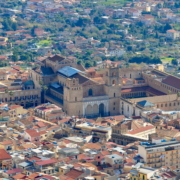
The archbishop of Monreale was the spiritual and temporal lord of his diocese, which was the largest and richest diocese of Sicily: at the moment of its foundation, the church founded by the Norman William II received 72 fief. Witnessing such important historical traces allows us to better know our roots