THE LIBRARIES OF MONREALE
 Ancient Fund of the Municipal Library “Santa Maria la Nuova”
Piazza Guglielmo II n°3, 90046 Monreale (PA)
The Norman king William II called the Benedictines from Cava dei Tirreni to administrate the new church he had founded. The Benedictines possessed many ancient books: the first nucleus of the library “Santa Maria La Nuova” dates back to the arrival of the monks who received many privileges from king William: among other things, the abbot was elevated to the rank of archbishop and the abbey was given “libris et sacris vestibus argento et auro”. The monks took great care of the books received as gifts and all the parchments, along with the abbey’s privileges, however, the death of the sovereign and the rush of events led to their dispersal.
The library was rebuilt after about 200 years, but in 1591 the difficult coexistence between the Benedictines and the secular clergy forced the Archbishop Ludwig II Torres to dismember it, dividing the books between the Benedictines, the seminary library and the Capuchin convent.
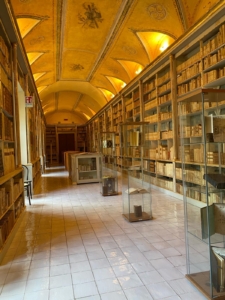
Around the second half of the 18th century, the Benedictine monks added a large hall with frescoed barrel vaults and an antique white majolica floor to the library. Until 1866, access was allowed only to monks and students of the novitiate school. In 1875, the monastery was ceded to the Town Hall and in 1877 the Monreale Municipal Library “Santa Maria La Nuova” was established; its bibliographic heritage was increased with books from the Benedictines of the nearby San Martino delle Scale and with books from the Capuchin monastery.
The Ancient Fund of the Monreale municipal library is housed in valuable wooden shelving with gilded grooves. It consists of over 10,000 editions from the 16th, 17th and 18th centuries, a nucleus of valuable manuscripts from the Middle Ages, incunabula and other bibliographic rarities. Among the most curious finds is a fragment of an 11th-century Gospel Book, used as a book cover: written in the scriptorium of the Benedictine monastery of Cava dei Tirreni, it was taken to Monreale by the first monks. Among numerous valuable old books there is also a copy of the first book printed in Sicily, in 1478.
Modern Fund of the Municipal Library “Santa Maria La Nuova”
Pietro Novelli Street n°5, 90046 Monreale (PA); from Monday to Thursday, from 8 a.m. to 7 p.m. and on Friday from 8 a.m. to 1:30 p.m.
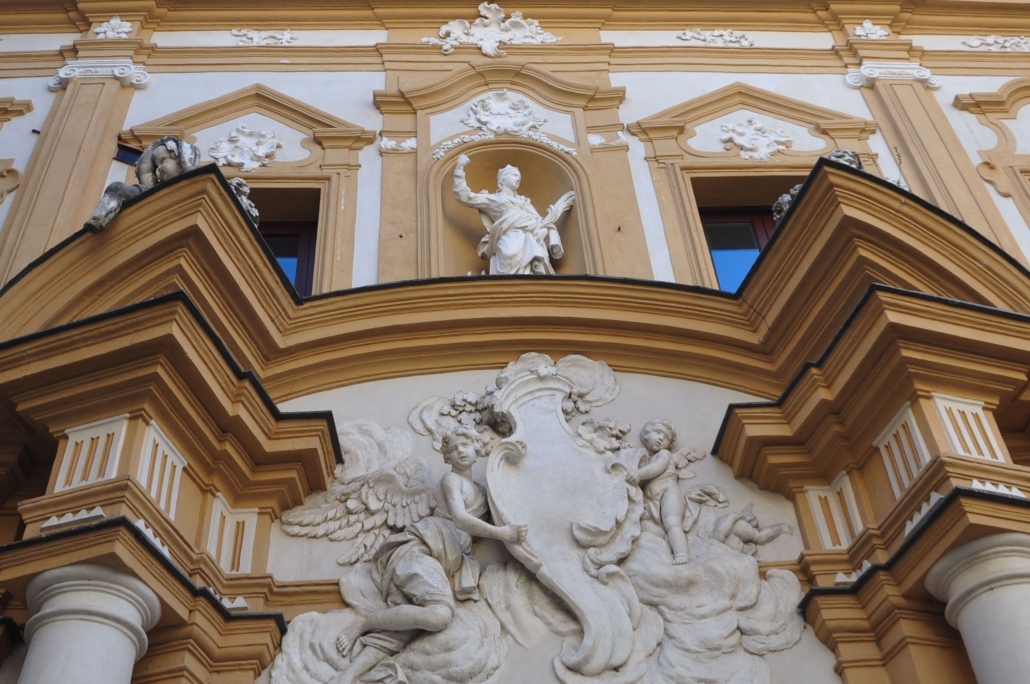
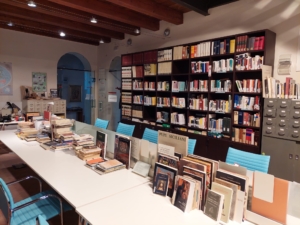 The Modern Fund, located inside the former “Saint Catherine Hospital”, is one of the two libraries that compose the Municipal Library “Santa Maria La Nuova”. The building, dating back to the 16th century, has a pretty Baroque façade and it’s located in the historical centre, inside the Carmine neighbourhood.
It’s considered a landmark for Monreale’s citizens and for this reason it’s it is often used as a place for projects involving book writers and reading promotion dedicated to every age range, with the collaboration of many institutions, associations, schools, universities and other entities operating within the territory. Reading circles often decide to meet up at the library in order to talk and discuss together about books they have red, sharing the pleasure of reading and discussing various topics together. The library also offers guided tours in order to get to know the places, the services, the collections and its activities.
“Ludwig II de Torres” Library
Arcivescovado Street n°2, 90046 Monreale (PA); from Monday to Friday, from 9.30 a.m. to 13.30 am.
 Built at the behest of Cardinal Ludwig II de Torres, a new library was added to the 1st floor of the newly founded archiepiscopal seminary in 1591; an inscription under the central window reminds us of its purpose: ‘Religioni et bonis artibus’, transmission of faith and the liberal arts.
The Archbishop Ludwig II de Torres was one of the cultural protagonists of his time,; we have a report of what Benedictine Michele del Giudice wrote in 1702 about the library founded in the seminary: “he enriched the seminary with his most noble library, copious with more than 50 armoires of volumes, the most singular in all subjects printed at that time, and obtained from Clement VIII a bull of excommunication against anyone who tried to take books or folios from it for any reason….”.
Other archbishops such as Girolamo Venero, Francesco Testa and Benedetto Balsamo increased its value by donating their books.
The Archbishop Ludwig II de Torres donated his picture gallery to the Library: of the “almost three hundred portraits” of illustrious men reported by the Benedictine del Giudice, 168 remain but, placed in the great hall above the valuable wooden shelving, they create an unusual and particularly evocative environment.
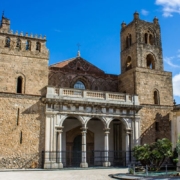
The Dome of Monreale is an architectural marvel of Romanesque-Latin-Norman-Byzantine style: it is simple, majestic and severe. It shows off a great profusion of wealth, with mosaics on a gold background surrounding the internal of the Dome for more than six thousand square meters…
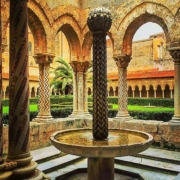
The Benedictine Cloister was part of the monastery and is one of the most important cloisters of all the Mediterranean area. It’s the heart of the entire Abbey Complex and It is a wonderful example of Byzantine architecture in Sicily…
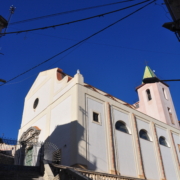
At the end of the 16th century, in Monreale’s neighbourhoods citizens started building many churches and chapels in order to express their religious devotion and show their charitable commitment to God, emphasizing their sense of brotherhood. Those buildings use the Baroque architectural canons…
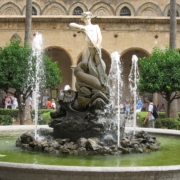
Being a town built on the slopes of Mount Caputo, fountains are essential. The lower part of Monreale benefits from the water taken from the Oreto river, but at the same time has no water sources in its upper part. An archbishop in the 1700s decided to solve the problem by building an aqueduct to bring water to the homes of inhabitants of Monreale…
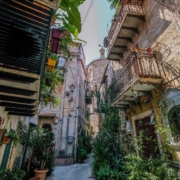
In the Historia della chiesa di Monreale, published in 1596 by the archbishop Ludovico II Torres with the pseudonym of Gian Luigi Lello – his personal secretary – we read that Monreale was divided into four parts. The first and most ancient, the Pozzillo, took its name from the flowing water…