
ARRIVING TO MONREALE
Monreale is 8 km from the centre of Palermo and benefits from easy connections with the airport, railway station, long-distance bus terminal and port.
Those who do not arrive by their own transport and do not want to use a taxi can choose the bus that passes by Piazza Indipendenza (near the Royal Palace of Palermo), which is very well connected to the central station and the adjacent bus terminal.
Those arriving by plane or from the port must first go by bus or metro to Palermo’s central station.
Those who choose the metro can get off at the Orleans-Palazzo Reale station to quickly get to Piazza Indipendenza, and from there to Monreale.
THE DISTANCES
- from Piazza Indipendenza (bus terminus in Palermo) km 8
- from the Central Station of Palermo km 10.4
- dal terminal bus of Palermo km 10,4
- from the airport of Palermo km 35
- from the airport of Trapani km 97,4
- from the airport of Catania km 211
The city
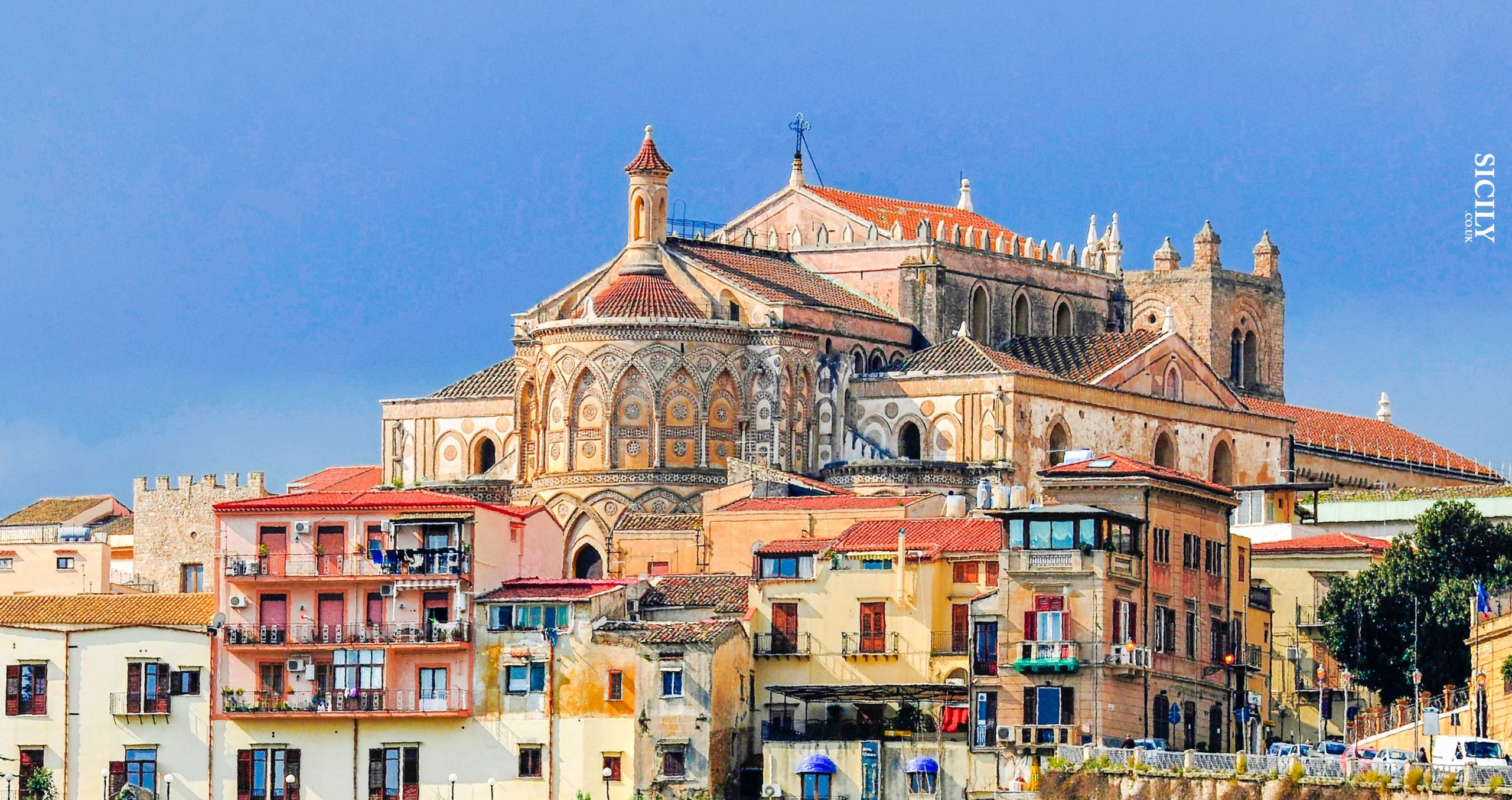
A few kilometres from Palermo, Monreale climbs Mount Caputo dominating the Oreto valley and the Conca d’Oro. It is the most important tourist centre in the province.
Monreale was founded by the Normans on a pre-existing Arab settlement and is within the large park created at the gates of the capital and intended for hunting. The construction of the cathedral is the event from which the town originated. Legend has it that one night in 1131, the Virgin Mary appeared in a dream to William II, known as the Good, revealing to him the hiding place of a precious treasure that would be used to build a temple dedicated to the Virgin: having found the treasure, the king immediately began the construction of Santa Maria la Nuova, the church that would amaze the world with its beauty.
Historians have given a different interpretation of the same events, observing how soon, in the Sicily that had returned to Christianity with the arrival of the Normans, the struggle between the not strong enough sovereign and the too powerful barons began. The turning point came when the pope and the king united against the barons and the archbishop of Palermo Gualterio Offamilio: the outcome of the clash became visible a few miles from the capital, where an imposing architectural complex dedicated to Our Lady was built. The new abbey is enriched with much land, and Benedictines from Cava dei Tirreni are called in to officiate at its rites; moreover, since there are only woods, countryside and Muslim settlements around it, it is the king who brings the men who must populate and defend the newly founded city.
The miracle of the building of the cathedral is soon accomplished. Within a few years, Byzantine, Arab and Latin craftsmen created one of the highest examples of Arab-Norman art, and in 1183, to the eternal indignity of the archbishop of Palermo, Pope Lucius III granted it the dignity of metropolitan church.
In the long Middle Ages, the cathedral of Monreale was the most powerful of the Sicilian ecclesiastical seigneuries, a privilege of 1182 drafted in the three languages of the royal chancellery – Latin, Greek and Arabic – defined its territory and declared it the mistress of 72 fiefdoms. But much of the land was in the hands of the Saracens, and only after a long internal crusade and slow repopulation did it come to yield rents and rights.
Surrounded by walls with 12 towers, the abbey is a fortified citadel. Rather than the Cluniac abbey models, it can be traced back to the mosques of Islamic cities: from the apses facing east to the architecture of the cloister, the cathedral of Monreale tells us of a multi-ethnic but not pacified Sicily, where the Latin element slowly prevails.
Until 1812, when feudality was abolished in Sicily, Monreale retained the rank of ecclesiastical lordship. It is a small theocracy where the archbishop is both temporal and spiritual lord, and his privileges include the power to administer justice at the various levels of judgement.
Thanks to the prestige and wealth of its archiepiscopal canteen, especially in the early centuries, the diocese of Monreale saw successive archbishops belonging to the most important families of Christianity.
For further information
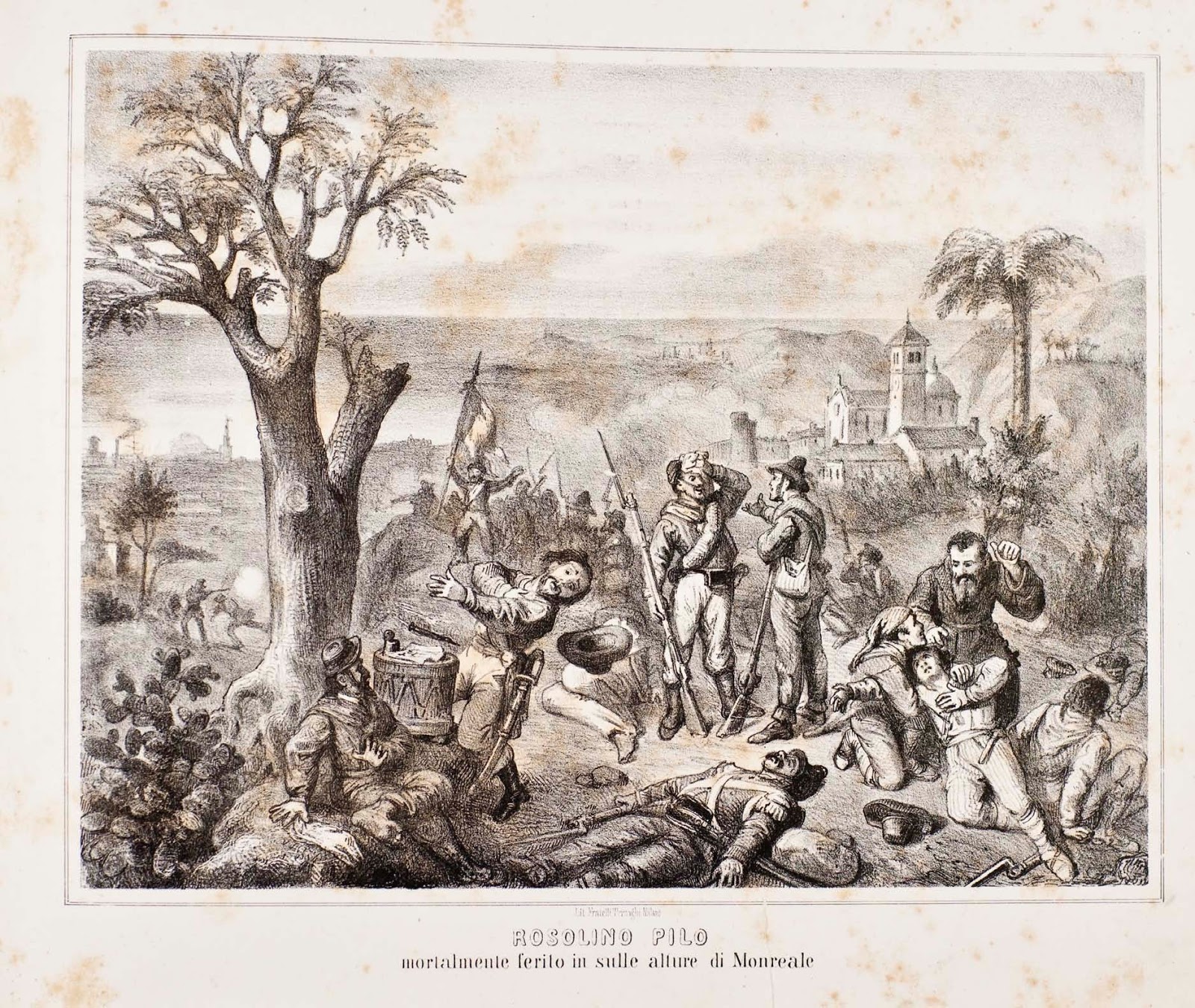
MONREALE INSIDE THE HISTORY OF THE THOUSAND
The beautiful Norman town in May 1860 was a real Bourbon stronghold. Monreale is important because it was in its territory that the new war scenario was concentrated in the territories of San Martino, Pioppo and Piano Renda (or Passo di Renna).
Garibaldi in fact ordered Rosalino Pilo and Corrao from the Renna camp to surprise the Bourbons on the flank of San Martino to force them to retreat and attempt his entry into Monreale.
(Silvia Sonetti, The war for the Independence)
In reality, the town was well garrisoned by the 9th Battalion led by Major Ferdinando Beneventano del Bosco and Von Meckel’s men, to which Colonel Buonopane’s contingent was also added.
Rosalino Pilo lost his life on the heights of San Martino, and it was immediately clear to the General that he could not sustain the fight: it was at this moment that he planned his escape from Pioppo through the Renna Pass and the Caculla forest, which still today create a unique landscape.